Washers
A guide to the Samsung top-load, front-load and combo washers we repair around San Francisco, with the common symptoms, codes and safe…

Specialized Samsung Appliance Repair in San Francisco
Mon–Sat: 8:00 AM – 7:00 PM
Fill, drain, door-lock and spin faults each leave different clues, and the closet or stacked setup often shapes the repair.
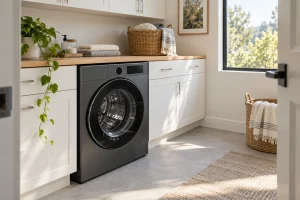
A washer sits at the intersection of water, electricity and motion, so when a Samsung washer misbehaves the clue is often in how it fails: it will not start, it will not fill, it stalls with water in the drum, it shakes across the floor, or it leaves a damp, sour smell behind. In San Francisco, where laundry often lives in a hallway closet, a garage corner or a shared basement room, the setup around the washer shapes the repair as much as the washer itself. We diagnose front-load, top-load and washer-dryer combo models, including Bespoke laundry units.
A washer that clicks, hums and never fills usually has a supply problem before it has a component problem: a half-closed valve, a kinked hose or a clogged inlet screen. If those are clear, a technician looks at the water inlet valve and the signal that tells it to open. Our troubleshooting post on a washer that will not fill or fills slowly lists what to look at first.
Standing water points toward the drain path: a blocked pump filter, a pinched drain hose, a standpipe that is too tight or a drain pump that is not turning. The drum may also refuse to spin until it empties. See washer will not drain, water stays in the drum for the owner-safe steps.
Violent movement during spin is often an unbalanced load or an unlevel floor, but a worn drum bearing, a loose shock or a foreign object between the drum and tub produces a different, deeper noise. Take a short phone video of the sound; our guide to washer grinding, rattling and knocking explains how to describe it.
Water at the front of a front-load washer is often a door boot that is torn or holding debris, or a dispenser drawer that overflowed. Water at the back or base can be a hose connection. Match the spot to our post on leaks at the door or dispenser.
The washer will not run if it does not sense a closed and locked door. A misaligned latch, a worn strike or a sensor fault can all cause a stall; a cycle that simply pauses may be a suds condition or a load being rebalanced, which is not a failure. Read why a washer stops mid-cycle before assuming the worst.
Odor usually comes from moisture trapped behind the door seal and in the drawer area. Occasionally a slow drain keeps water sitting in the tub; see musty smell after a cycle.
We ask what the washer did right before it failed: which cycle, what load size, whether the power flickered. Then we confirm the model, read any code, and check the installation before opening anything, including the levelling feet, the hoses and the drain connection. Tests follow the symptom, from the inlet valve to the pump to the door lock and the control. You get a written estimate after the diagnosis, and no repair starts without your approval.
Samsung displays short codes, and several have more than one spelling. Always note the exact characters. Pages we have prepared:
Some code names overlap with other meanings on different models, so the model number matters when reading them.
Stacked laundry is common in Bay Area flats: a dryer mounted above a front-load washer shares a footprint, and pulling the washer out to reach the back means taking the pair apart. A washer in a closet may have less than a hand’s width at the rear, which strains hoses and hides leaks. Wood-framed upper floors flex under a spinning load, so a washer that behaves in a garage can shudder in a second-story unit. Drain standpipes also vary; one that is too short can siphon, and one that is too tight can slow draining. Tell us about stacking, floor type and access when you book, and about any building rules on moving equipment.
Leave the cabinet panels closed and do not bypass the door switch. Never run the washer with a leak you cannot trace.
Stop if water is running onto the floor, if you smell burning or see smoke, or if the drum rubs and grinds. Shut off the supply valves and, if there is any sign of heat, switch the breaker off. Standing water in a drum that will not drain should also be left alone until it is checked, because the door may not release safely.
Samsung makes front-load washers, top-load washers and washer-dryer combos, and their pumps, locks and controls differ. The label is usually found inside the door frame or on the back panel; see where to find your Samsung model number.
For lineup details, read our Samsung washers guide. Models often brought to us include the WF45T6000AV/A5 front-load, the WA45T3200AW/A4 top-load and the WD53DBA900HBA1 combo.
It usually cannot drain, or it cannot confirm the door is locked. A clogged pump filter, a pinched hose or a latch fault are the likely directions. A technician tests each before suggesting a part.
Mild movement from an uneven load is common. Violent shaking, loud knocking or a drum that scrapes means stop the cycle and book a diagnosis.
Many models have an access door near the bottom front. Follow the owner’s manual, put towels down because water will come out, and do not force anything that does not open easily.
Yes, including Bespoke combo units. They have a washer side and a drying side, so we ask which function fails.
The model number, the exact code, what the washer did before it stopped, and whether it is stacked under a dryer or in a closet.
A guide to the Samsung top-load, front-load and combo washers we repair around San Francisco, with the common symptoms, codes and safe…
Samsung gas, electric and induction cooktop repair across San Francisco and the Bay Area: burner, zone and touch-control faults diagnosed before any…
Diagnosis for Samsung dishwashers in San Francisco and the Bay Area, covering drain faults, leaks, fill problems and noisy pumps in tight…
Diagnosis for Samsung electric, gas and heat pump dryers in San Francisco and the Bay Area, from long dry times to door…
Samsung over-the-range and countertop microwave repair in San Francisco and the Bay Area, from no heat and door faults to arcing and…
Diagnosis for Samsung gas, electric, induction and dual-fuel ranges and wall ovens in San Francisco and the Bay Area, with a written…
Diagnosis for Samsung French-door, side-by-side and top-freezer refrigerators in San Francisco and the Bay Area, from warm compartments to ice makers.
Share a few details and we’ll confirm an appointment. Prefer to talk? Call us and we’ll help right away.