

Specialized Samsung Appliance Repair in San Francisco
Mon–Sat: 8:00 AM – 7:00 PM
Not sure where the model number sits on your Samsung? Here is where the label usually hides on each appliance and how to read it correctly.
When you call about a Samsung appliance that has stopped behaving, the first thing a scheduler asks for is the model number. It is not a formality. The same product name can cover several builds, and the exact label decides which parts, wiring and control board a technician should expect to find. Spending two minutes with a phone camera before you book means a better-prepared diagnosis later.
Samsung sells lookalike appliances that differ inside. Two French-door refrigerators can share a silhouette and still use different ice systems, and two dishwashers can look identical from the front while their drain and spray hardware differ. A written model number lets a technician check the parts diagram before arriving rather than on your kitchen floor. It also tells you whether the appliance is still sold in the current catalog, which feeds into the repair-or-replace conversation.
Every appliance family has a habitual spot, though placement varies by build, so treat these as the usual places rather than certainties.
You do not need a decoder to be useful, but the first letters hint at what you own. RF is a French-door refrigerator, RS a side-by-side, RT a top-freezer. WF is a front-load washer, WA a top-load washer, and WD or WH a washer-dryer combo. DV is a dryer, with DVE for electric and DVG for gas. DW is a dishwasher, NSG a gas range, NSI an induction range, NSY a dual-fuel range. ME marks an over-the-range microwave, and MC or MS a countertop one.
Read the whole string, slash included. A label such as RF22A4111SR/AA ends in a suffix, and that suffix can matter. Copy it exactly as printed, letter O versus digit zero included. If you want a sense of how a full entry looks, browse our Samsung model pages or open one such as the RF22A4111SR/AA Bespoke refrigerator page.
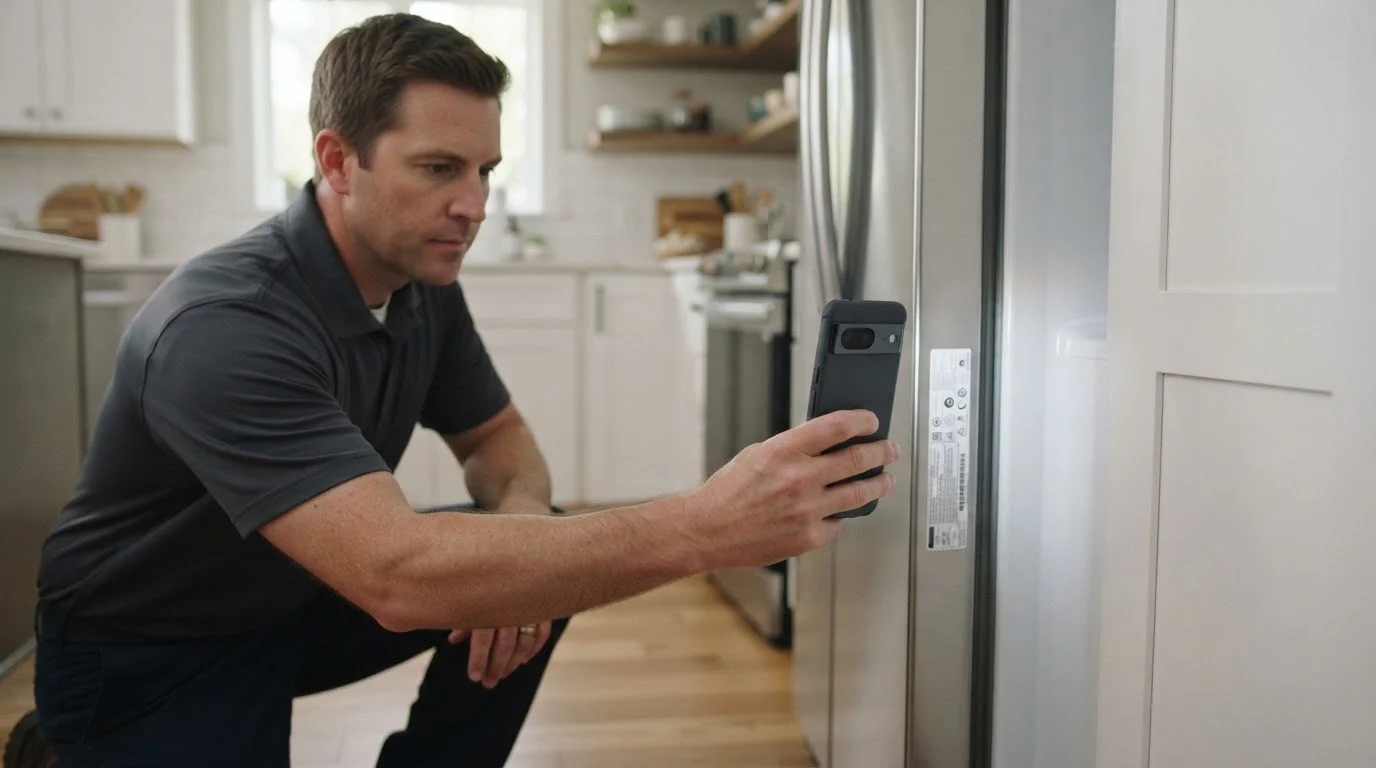
Stickers fade, curl and sometimes vanish after years of steam or cleaning. Photograph the label while it is readable, and keep the picture in your phone with the appliance’s name. If the label has partly peeled, shoot it at an angle in good light; flash often washes out a glossy sticker. Write the number on a note as well, since a transcribed string is easier to read aloud.
Many households in San Francisco flats and Bay Area condos have appliances installed in closets or tight alcoves, where the label faces a wall. In that case, do not pull a heavy unit out by yourself. Check whether the number is also on the original paperwork, the purchase email, the manual, or the SmartThings entry for a connected unit. If none of those exist, tell the scheduler where the appliance is built in and we will work from there.
A few other details speed up a first conversation:
Do not unscrew panels to find a hidden sticker. Do not slide a gas range sideways, because the flexible connector behind it is not made to be stretched. Do not tilt a refrigerator forward with the doors loaded. Do not peel a label off to read it. If the number is not reachable safely, a photo of the unit plus its approximate age is enough to start, and the technician can read the label once the appliance is accessible.
With the number in hand, pick the page that matches your appliance: Samsung refrigerator repair, Samsung washer repair, Samsung dryer repair, Samsung dishwasher repair, Samsung range and oven repair, Samsung cooktop repair or Samsung microwave repair. Our process is the same for each: diagnosis before repair, a written estimate, and nothing repaired without your approval.
If you manage several units, keep a simple record: unit number, appliance type, model number and the date you photographed the label. When a tenant calls about a failed washer in a Mission District flat or a dishwasher in a Sunset row house, you can pass along the model immediately instead of asking the tenant to hunt behind a unit. A shared photo folder organized by address saves repeated calls, and it helps when a building has a mixed set of appliances installed over different renovations.
No. The model number identifies the design of the appliance, while the serial number identifies your individual unit. Both are usually printed on the same label, and giving both helps when a scheduler checks which build you own.
Yes, as a backup. Paperwork sometimes shows a shortened version of the code, though, so compare it with the label on the appliance whenever you can reach it. If they differ, send both.
Send a photo of the whole appliance, its location in the home, and anything you remember about the purchase. A technician can often identify the build from the control layout and the hardware, then confirm it during the visit.
No. It tells a technician what hardware to expect. The symptom, any display code and the checks done at the appliance are what point to the fault, which is why we diagnose before recommending a repair.
Suffixes often mark color, region or a small build variation. A part that fits one variant may not fit another, so the complete string keeps the parts list accurate.
Share a few details and we’ll confirm an appointment. Prefer to talk? Call us and we’ll help right away.