Dishwashers
The Samsung dishwashers we repair in San Francisco kitchens, with common drain, fill, drying and leak complaints plus safe owner checks.

Specialized Samsung Appliance Repair in San Francisco
Mon–Sat: 8:00 AM – 7:00 PM
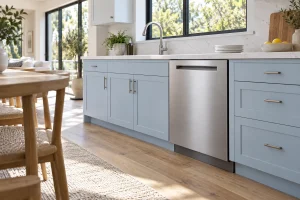
Drain path, supply and pump faults on an undercounter Samsung dishwasher often start with the installation under the sink.
A Samsung dishwasher that leaves a gritty film, stops with water at the bottom or runs for hours without drying is easy to blame on the detergent. Sometimes it is, but just as often the cause is mechanical: a clogged filter, a drain path that backs up from the sink, a spray arm that no longer turns or a heating circuit that does not finish the job. In San Francisco kitchens, where a dishwasher may share a drain with a garbage disposal in a tight cabinet run, the installation matters as much as the machine. We diagnose standard and Waterwall models and the larger 48 inch and 38 inch units.
Water left in the tub usually means the drain path is restricted. The suspects are the filter and sump, the drain hose with a kink or a high loop that is missing, the disposal knockout plug left in place after installation, or a drain pump that hums without moving water. Our post on a dishwasher that will not drain shows the outside checks.
If the dishwasher takes in water and then goes quiet, the machine may be waiting on a level reading, a circulation pump or a door signal. Read fills then stops washing for the sequence of things to watch.
Water at the floor can come from the door gasket, an overfilled dispenser, a loose supply fitting or a cracked hose underneath. We look for the first point of wetness before judging. See leaks at the bottom of the base.
A drying problem can come from a vent, a rinse aid reservoir that has run out or a heating element that is weak, and a pod that stays whole in the dispenser may signal a stuck dispenser door. We cover both in dishes not drying and pod not dissolving.
A glass shard in the sump, a loose spray arm or a worn pump bearing all sound alike from across the room. Our article on dishwasher grinding and humming describes the differences.
We ask which cycle you run, whether the problem is new, and what changed recently, such as a new disposal, a moved cabinet or a power flicker. Then we check the model and the code, look at the supply and drain connections, and test the system that fits the symptom: inlet valve, pump, spray arms, dispenser and heater. A written estimate follows the findings, and no repair begins without your approval.
Samsung dishwashers display compact codes. We have these pages:
A code names a circuit or symptom, not an automatic part replacement.
An undercounter dishwasher shares its space with a sink drain, a supply line and often a disposal. If the drain hose does not rise into a high loop under the counter, or connects to a disposal whose knockout plug was never removed, water struggles to leave. A supply that is only partly open gives a fill fault or very long cycles. The unit also must be level and fastened under the counter so the door closes squarely. In older homes, ground-floor flats and rentals, we often find that previous repairs left hoses stretched or pinched. Tell us if there is a disposal, an air gap, or limited cabinet clearance.
The door and the dispenser also depend on how the unit sits. A dishwasher that has settled forward can let the door drop slightly, so the latch engages poorly and the gasket leaks at one corner. We check the leveling feet and the mounting brackets as part of every visit, and we explain what we see before suggesting a repair. If a dishwasher was recently moved for a countertop or flooring project, mention it; supply and drain fittings are often disturbed during that kind of work.
Do not open the lower access panel to handle wiring, and do not run a unit that leaks onto the floor.
Turn the dishwasher off and shut the supply if water leaks onto the floor or toward cabinets. If you smell burning, or the unit trips the breaker, leave the breaker off. Standing water with a bad odor can wait for a visit, but do not keep running cycles into a blocked drain.
Samsung dishwashers differ in sump design, in Waterwall features, and in door and control layout. The label is usually along the edge of the door or inside the tub rim. Our model number guide lists the usual spots.
For lineup details read the Samsung dishwashers guide. Models we are asked about include the DW70H83YETRAA, the DW90H89TETEAA and the DW50T6060US/AA.
A restricted drain is the likely direction: filter, hose, disposal connection or pump. We test the path before replacing anything.
Not necessarily. It means the dishwasher cannot drain, and a clog or a kinked hose produces the same code as a failing pump.
No. Water near the floor or cabinets can damage flooring and electrics. Keep it off until the source is found.
Yes. Waterwall units add a reflector and a filter path, which we include in the diagnosis.
The model number, the code and whether there is a disposal or air gap.
The Samsung dishwashers we repair in San Francisco kitchens, with common drain, fill, drying and leak complaints plus safe owner checks.
Samsung gas, electric and induction cooktop repair across San Francisco and the Bay Area: burner, zone and touch-control faults diagnosed before any…
Diagnosis for Samsung electric, gas and heat pump dryers in San Francisco and the Bay Area, from long dry times to door…
Samsung over-the-range and countertop microwave repair in San Francisco and the Bay Area, from no heat and door faults to arcing and…
Diagnosis for Samsung gas, electric, induction and dual-fuel ranges and wall ovens in San Francisco and the Bay Area, with a written…
Diagnosis for Samsung French-door, side-by-side and top-freezer refrigerators in San Francisco and the Bay Area, from warm compartments to ice makers.
Diagnosis for Samsung front-load, top-load and combo washers in San Francisco and the Bay Area, covering fill, drain, door and vibration problems.
Share a few details and we’ll confirm an appointment. Prefer to talk? Call us and we’ll help right away.