Dishwasher Repair
Diagnosis for Samsung dishwashers in San Francisco and the Bay Area, covering drain faults, leaks, fill problems and noisy pumps in tight…

Specialized Samsung Appliance Repair in San Francisco
Mon–Sat: 8:00 AM – 7:00 PM
Understand the common faults, read the code and run the outside checks before booking a visit.
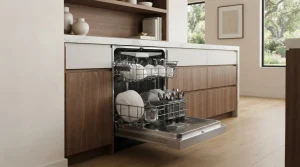
Dishwashers in San Francisco kitchens are usually tucked between narrow cabinets, often near a shared sink drain and a short supply line. That tight fit shapes almost every repair on the models below.
All five are current catalog models. The prefix DW identifies the dishwasher family.
On a dishwasher the model label is usually on the edge of the door or along the inner tub frame, visible when the door is open. Take a photo of it, along with any code on the display.
Several dishwasher codes are covered below. 5C is a drain error, 4C is a water supply error, LC is a leakage error, and tE is a temperature sensor error. HC is a high temperature heater error. Browse the error code library for other entries.
Do not take off the kick plate or lower panel to reach wiring. If water reaches the floor, close the supply valve and stop the unit.
Once the easy checks are done, the Samsung dishwasher repair page explains how a visit works. Send a request on the contact page and expect a diagnosis first, a written estimate, and repair only with your say-so. For rattling sounds, see this noise guide.
Under-counter space is tight in most San Francisco kitchens, so the drain hose often runs a long way to a shared sink trap or disposal. A kinked hose, a missing high loop or a disposal knockout plug left in place can all mimic a failed pump. The supply line usually has a small valve under the sink, and that valve is worth checking first when the tub fills slowly or not at all.
Cabinet and countertop fit matters as well. A unit that is not level may leak at the door, and a door that sags can fail to close on its latch. If your dishwasher was moved during a remodel, mention it when you book.
Rental kitchens add another wrinkle. Previous tenants may have swapped hoses or left a disposal plug in place, so a clear description of what you see under the sink saves time. Photos of the supply valve, the drain connection and the tub label are usually enough to start.
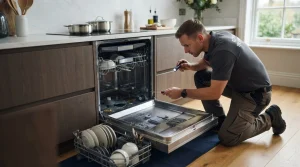
A technician reads the code, looks at the water path from supply to drain, tests the pump and the heating and drying circuit as the symptom suggests, and explains what was found before any part is ordered. You receive a written estimate and decide whether to go ahead.
Open the door and look at the door edge or the inner frame of the tub. It is usually printed there.
A closed supply valve, a weak door latch signal or a drain issue can all interrupt a cycle. Start with the valve and the door.
A blocked filter mostly causes poor draining, but backed-up water can then escape at the door. Cleaning the filter is a safe first step.
Write the code down and try one reset. If it returns, stop using the dishwasher until it has been diagnosed.
Make sure the disposal knockout plug was removed during installation and that the drain hose has a proper loop before blaming the pump.
Diagnosis for Samsung dishwashers in San Francisco and the Bay Area, covering drain faults, leaks, fill problems and noisy pumps in tight…
The DW50T6060US/AA is a current Samsung dishwasher. See how stuck-button and no-start messages are separated from real board faults.
The DW60R2014US/AA is a current Samsung dishwasher. Read how low-water and supply messages are traced from the valve to the tub.
The DW70H83YETRAA is a current Samsung dishwasher. Learn how leaks, standing water and drain messages are narrowed down at a Bay Area…
The DW70H83YEURAA is a current Samsung dishwasher. See how pump noise, spray problems and motor messages are diagnosed in the Bay Area.
The DW90H89TETEAA is a current Samsung dishwasher. Here we explain drying faults, heater messages and what to check before booking a Bay…
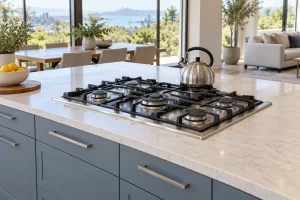
How Samsung gas, electric and induction cooktops differ, what their codes mean, and which owner checks are safe before booking a San…
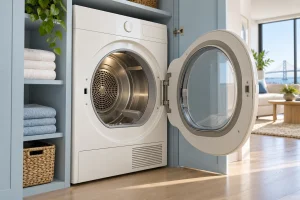
Electric, gas and heat pump Samsung dryers we repair in San Francisco, with vent-related symptoms, codes and safe owner checks.
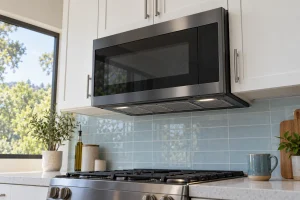
Samsung over-the-range and countertop microwaves we repair in San Francisco, with common faults, display codes and outside-only owner checks.
Samsung gas, induction and dual-fuel ranges we repair across San Francisco, with igniter, oven heat and panel complaints and safe owner checks.
Browse the Samsung French-door, side-by-side and top-freezer refrigerators we repair across San Francisco, with Bespoke and Family Hub models.
A guide to the Samsung top-load, front-load and combo washers we repair around San Francisco, with the common symptoms, codes and safe…
Share a few details and we’ll confirm an appointment. Prefer to talk? Call us and we’ll help right away.