Ranges and Ovens
Samsung gas, induction and dual-fuel ranges we repair across San Francisco, with igniter, oven heat and panel complaints and safe owner checks.

Specialized Samsung Appliance Repair in San Francisco
Mon–Sat: 8:00 AM – 7:00 PM
Burners that will not light, ovens that run cold or error codes on the display: we find the cause before anything is replaced.
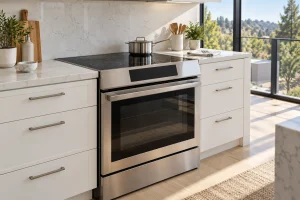
A Samsung range does two jobs at once, and a fault in one half can hide inside the other. The top may light and simmer perfectly while the oven stays cold, or the oven may bake well while one burner clicks without catching. In Bay Area kitchens, where a range is often squeezed between cabinets in a flat, a condo or a narrow row house, getting the symptom described clearly is half the repair. Here we cover Samsung gas, electric, induction and dual-fuel ranges, including Flex Duo and Bespoke models, and wall ovens.
On a gas range the usual story is ignition. A burner that clicks but never lights, a burner that lights and then keeps clicking, or a flame that is yellow, lazy or uneven all point at different things. Clicking without a flame can mean a wet or dirty burner cap, a blocked port, or a spark module that is not delivering. Continuous clicking after the flame is up often means the sensing is confused by debris or moisture around the igniter. Our guides on a Samsung gas range burner that will not ignite and on an igniter that keeps clicking after the burner lights walk through what an owner can safely look at first.
If the oven is the gas part, the igniter is again the suspect. A glowing igniter that never opens the gas valve is a different repair from an igniter that stays dark. We test which one we have before anything is replaced.
Electric and induction ranges bring a different list: a surface element that stays cold, a control panel that beeps and shuts a zone off, or an oven that heats on one side only. Induction adds a pan-detection step, so a zone that refuses to start is sometimes a cookware matter rather than a failed part. Dual-fuel models pair a gas top with an electric oven, which means a single complaint can belong to either system, and we separate them before touching anything.
A symptom alone rarely tells us whether the sensor, the heating element, the igniter or the board is at fault. That is why the visit starts with diagnosis rather than a parts list.
Samsung ranges report faults on the control panel, and the meaning depends on the exact message. A few examples: C-d1 points to the door lock, C-24 means the oven temperature is rising faster than normal and is usually linked to a blocked vent at the back of the cooktop, and bAd LinE means the power connection is not plugged in properly. Some messages are not faults at all. Pr E only says the oven is preheating, S-01 is a safety shutoff after the oven ran at one temperature for a long time, and tESt means the range is in Demo mode, so the oven and electric cooktop will not heat. On induction models, the underlined u is a pan detection message. Write down exactly what you see before you reset anything.
Where and how the range is connected matters. A freestanding gas range sits on a flexible gas connector with a shutoff valve behind it, and anything that involves that fitting is outside what an owner should touch. An electric or induction range runs on a dedicated circuit and a heavy cord or hard-wired connection, so a loose plug or a tripped breaker can imitate a dead oven. Slide-in styles sit flush with the counters, which leaves little room to reach the back. In older San Francisco buildings we also meet ranges moved after a remodel, anti-tip hardware left off, and vent hoods that were never connected. All of that shapes what we check and how we pull the range out.
Do not remove panels, test live wiring, adjust gas fittings or bypass a door switch.
If you smell gas, leave the home, avoid switches and phones inside, and call the gas utility or 911 from outside. If you notice a burning smell, sparks, or a burner that will not shut off, turn the range off at the breaker and leave it off. A door that cannot be closed, or a surface that stays hot with the controls off, also means stop and book a visit rather than waiting for the next meal.
Samsung builds ranges on several platforms. An NSG model is a gas range, an NSI is induction, and an NSY is dual fuel, and the part that fits one will not fit another. The label is usually on the frame behind the oven door or on the edge of the oven cavity. With the number in hand we can read the right sequence for the code, the right ignition setup and the right control board. If you are not sure where to look, our guide to finding the model number before repair shows the usual spots.
We confirm the fuel type and the symptom, check the connections and error history, and test the failing function directly. You get a written estimate before any repair and nothing is replaced without your approval. If the range cannot be made safe in one visit, we say so and explain what is left.
For the full lineup, start with Samsung ranges and ovens. Model pages include the Samsung NSG6DB830012AA repair page for a Bespoke gas range, the Samsung NSI6DB930012AA repair page for a Bespoke induction range and the Samsung NSY6DG8550SRAA repair page for a Bespoke and Flex Duo dual-fuel range. Related: a Samsung cooktop repair request if only the cooktop is installed in your counter.
Yes. A wall oven is diagnosed the same way, with extra attention to the cabinet cutout, ventilation around the unit and the cord or hard-wired connection.
Turn the burner off and ventilate if you smell gas. If there is no smell, check that the cap is seated and dry. If it still will not light, book a diagnosis rather than trying again many times.
Write the code down first. One controlled reset at the breaker is reasonable, but a code that returns tells us something real, so keep a note of when it appears.
The two cavities share controls but have their own heating and sensing parts. Tell us which side fails and whether the divider was in place.
It helps a lot, but a photo of the label or a description of the range is enough to start the request.
Samsung gas, induction and dual-fuel ranges we repair across San Francisco, with igniter, oven heat and panel complaints and safe owner checks.
Samsung gas, electric and induction cooktop repair across San Francisco and the Bay Area: burner, zone and touch-control faults diagnosed before any…
Diagnosis for Samsung dishwashers in San Francisco and the Bay Area, covering drain faults, leaks, fill problems and noisy pumps in tight…
Diagnosis for Samsung electric, gas and heat pump dryers in San Francisco and the Bay Area, from long dry times to door…
Samsung over-the-range and countertop microwave repair in San Francisco and the Bay Area, from no heat and door faults to arcing and…
Diagnosis for Samsung French-door, side-by-side and top-freezer refrigerators in San Francisco and the Bay Area, from warm compartments to ice makers.
Diagnosis for Samsung front-load, top-load and combo washers in San Francisco and the Bay Area, covering fill, drain, door and vibration problems.
Share a few details and we’ll confirm an appointment. Prefer to talk? Call us and we’ll help right away.