

Specialized Samsung Appliance Repair in San Francisco
Mon–Sat: 8:00 AM – 7:00 PM
Pale on one side and burnt on the other? Learn how pan placement, door seal, sensor drift and heating parts affect baking, and what to check first.
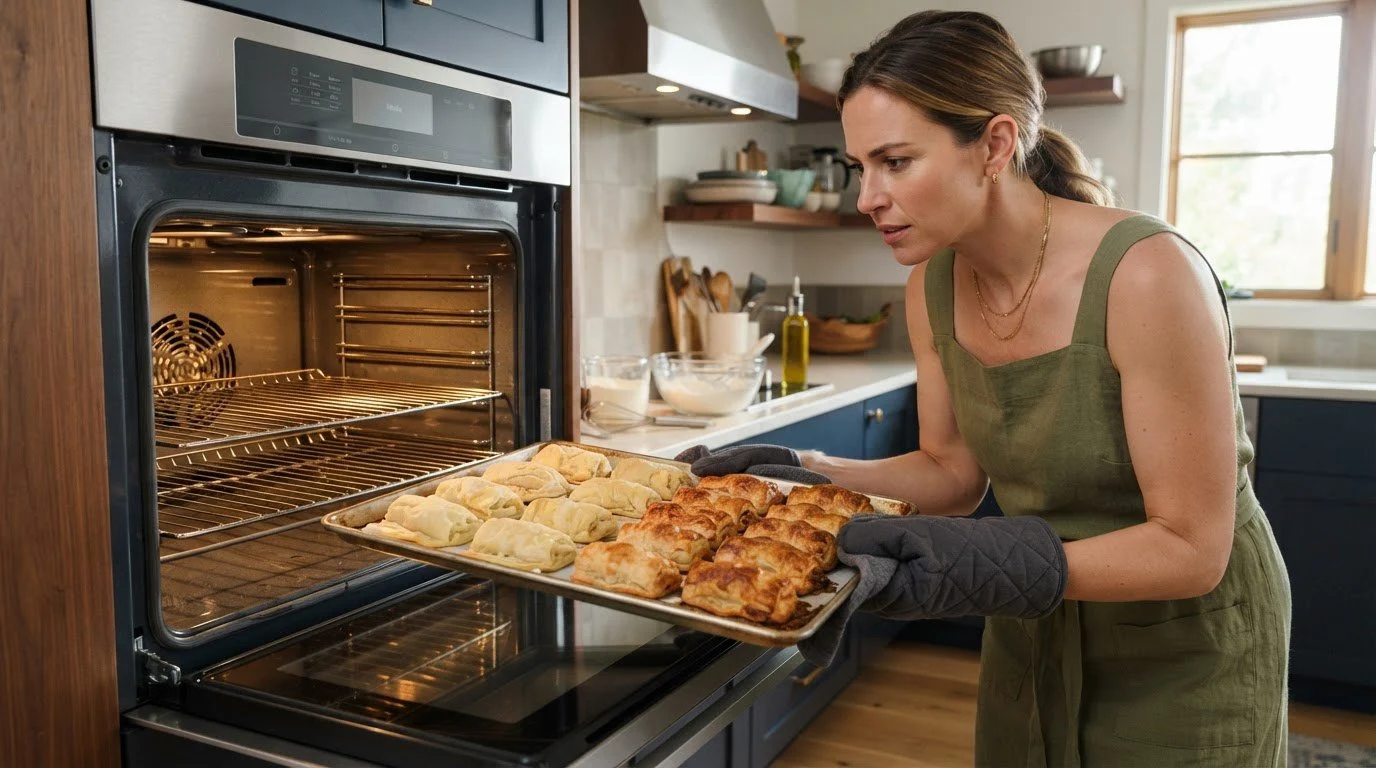
The cake is pale on one side and dark on the other, cookies on the back rack finish before the front ones, or the oven simply seems hotter than the dial says. Uneven baking is one of the most common oven complaints, and it comes from only a handful of causes. Some of them you can fix on a Saturday morning, and some need a technician with a thermometer.
An oven distributes heat by radiant elements and, in many models, a convection fan. Even good airflow is blocked by the way food is arranged. Large sheet pans pushed to the walls stop air from moving around them. Foil on the rack bottoms changes how heat reflects. Dark pans bake faster than shiny ones. Before suspecting a fault, change one thing: bake on the middle rack, with a pan that leaves a gap on all sides, and see whether the pattern shifts.
If the oven senses a problem with its temperature probe, it can show a sensor malfunction, which is described on the C-20 code page together with C-21 and C-22. If the oven temperature is rising faster than normal, the C-24 page points to a blocked vent at the back of the cooktop. A blocked vent can make the oven run hot, so look at the back of the range for anything sitting over the vent opening, such as a pan or a piece of foil. Not every uneven bake shows a code, so absence of a code does not clear the oven.
An oven thermometer placed in the center gives you a rough view, but treat its readings with care and do not rely on it for a technical judgment. It is more useful for showing a large difference than a small one.
Patterns tell a story. Edges brown while the center stays pale: the oven is likely fine and the pan is thick or dark. The back burns while the front stays pale: look at airflow and the vent. One side consistently darker than the other, in every pan and on every rack: suspect an element or the fan. Everything comes out pale and slow at the dial setting: the oven may be running cool, which links to the sensor. Bring these observations with you, because a clear pattern lets the technician test the right part first instead of working through every possibility.
A gas range, an electric range and a dual-fuel range heat differently. A gas oven fires a burner at the bottom and relies on circulation and the flame pattern. An electric oven uses elements above and below. A model with convection adds a fan, so a fan fault matters only if your range has one. In older San Francisco flats where the range sits a bit tilted on uneven flooring, batter pools to one side and looks like uneven heating. Check the level before blaming the oven.
Book when the same area burns every time even with a clean setup, when the oven is clearly hotter or colder than the setting, when a code appears, or when the fan makes noise or stays silent. A technician checks the sensor reading, the elements or burner, the fan, the door and the control, then tells you what failed. You get a written estimate, and nothing is repaired without your approval.
Start with Samsung range and oven repair and read Samsung ranges and ovens for the lineup and the label location. Models include the Samsung NSY6DG8550SRAA dual-fuel range, listed with Flex Duo. If your oven also takes ages to reach temperature, see oven takes too long to preheat.
Pan placement, a hot spot from a weak element or a convection fan that is not moving air are the common reasons. Try the middle rack and rotate the pan.
The manual may describe a temperature offset setting. Do not open panels or touch the probe. If an offset does not fix it, book a visit.
Possibly, but not always. Pan type, rack position and door sealing are more common causes.
Small differences are normal as the oven cycles. A large, consistent gap suggests a sensor or control issue.
No. Many oven problems do not show a code. Keep notes on the pattern and share them when you book.
Share a few details and we’ll confirm an appointment. Prefer to talk? Call us and we’ll help right away.