

Specialized Samsung Appliance Repair in San Francisco
Mon–Sat: 8:00 AM – 7:00 PM
A burner that clicks but never lights is usually dirty, damp or misaligned. Learn the safe checks, the gas-smell rule and when a visit is needed.
You turn the knob, hear the usual tick-tick-tick, and nothing catches. Or three burners light and the fourth stays dark. On a gas range this is a very common complaint, and in most kitchens the reason is simpler than people fear. It helps to sort it into two questions: is there a spark, and is there gas reaching the burner?
If you smell gas at any point, stop. Do not flip switches, do not use a lighter, and do not keep turning knobs. Leave the home, then call the gas utility or 911 from outside. Everything below assumes there is no gas smell.
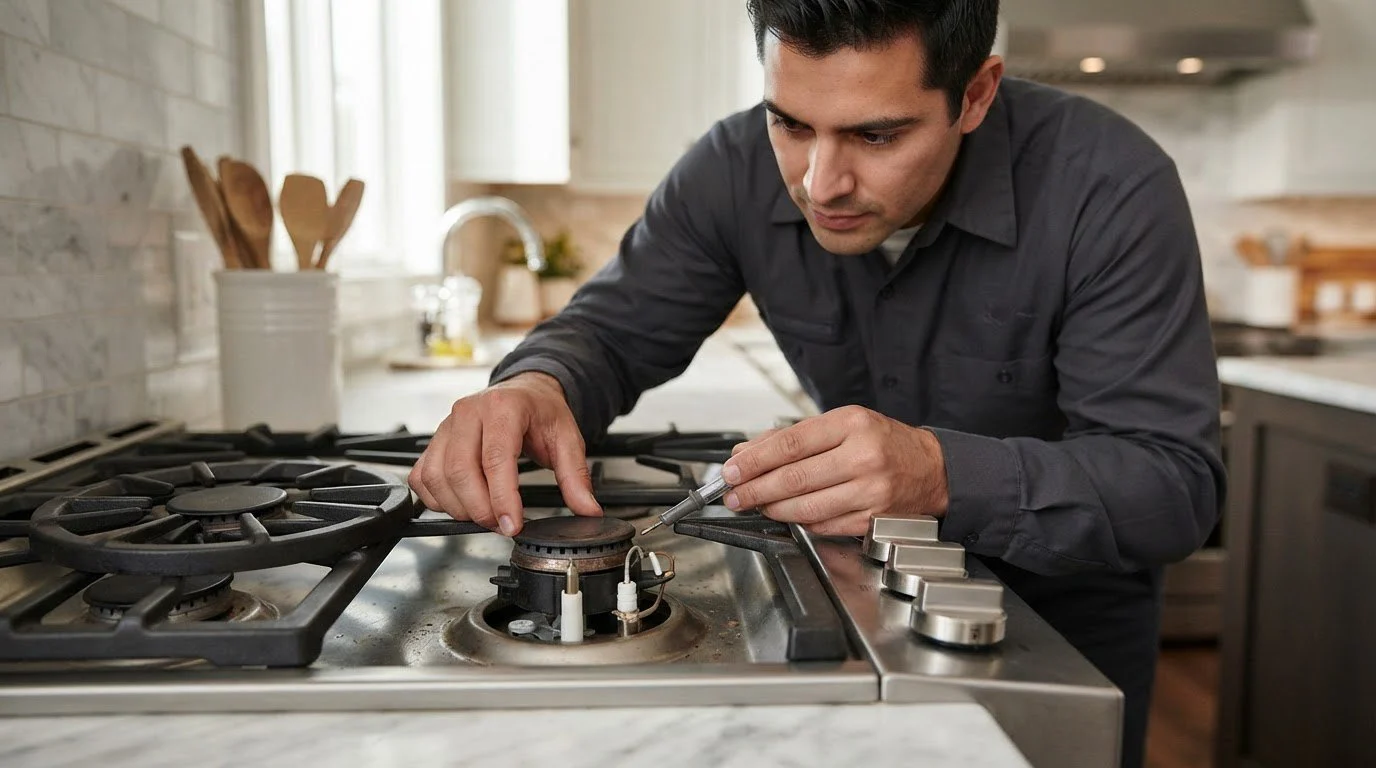
A gas burner is made of a base, a cap and a small spark electrode set close to the ports. Boil-overs and cleaning sprays leave residue that clogs the little slots where gas escapes. When the slots are blocked, gas cannot spread evenly, and the spark finds no mixture to ignite. The cap is also easy to put back crooked. If it rocks slightly or sits off the base, the flame pattern breaks and ignition fails.
Moisture is another quiet cause. A damp burner, after a wipe-down or a spill, can click without lighting for a while. In foggy coastal neighborhoods, a kitchen that stays humid can make that worse in the morning.
A pan that sits unevenly can smother the flame and push it out as soon as the knob is released. If a burner lights while the grate is bare but dies under a pot, the pot or the grate seating is part of the story. Try a flat pan, and make sure the grate sits level on its feet. Notice the flame color as well. A steady blue ring is normal; lazy yellow tips on a clean burner suggest an air or port issue worth mentioning to the technician.
If the clean, dry, correctly seated burner still will not light, the likely suspects move to parts you should not open: the ignition switch behind the knob, the wiring harness, or the spark module. These fail more often in kitchens where the range is pushed against the wall and the cord gets tugged. The result looks identical from the front, which is why a technician tests the spark and the gas path in order instead of swapping parts at random.
Many San Francisco flats and rentals have gas lines that run through the wall and a shutoff valve tucked behind the range. If you move in, remodel or slide the oven out to clean, the cord can end up pinched or the valve bumped. If the range lights unevenly after any of those, say so when you book. Earthquake shutoff devices on a gas meter can also interrupt supply to the whole home, so ask whether the water heater and furnace are working too.
Book when one burner will not light after cleaning, when none light with a gas valve confirmed open, when the flame is uneven or yellow on a clean burner, or if the knobs feel loose or gritty. A technician diagnoses first, gives you a written estimate, and does not repair anything without your approval. Start with Samsung range and oven repair, and use Samsung ranges and ovens for help finding the label inside the oven frame or near the drawer edge.
Gas models include the Samsung NSG6DG8300SRAA and the Samsung NSG6DB850012AA. If the burner lights but keeps clicking afterwards, see igniter keeps clicking after the burner lights.
The spark is firing but the gas is not catching. Blocked slots, a damp burner or a crooked cap are the usual reasons. Dry the parts, clean the slots and seat the cap flat before anything else.
Only if there is no gas smell. A few tries are fine. If you smell gas, leave and call the utility or 911 from outside, and do not touch switches.
Do not. Gas can collect while the igniter clicks, and a flame at that moment may flash. Let a technician handle a burner that will not light on its own.
Water or spray left on the burner, or a cap put back off-center, are the common reasons. Let it dry fully, then reseat the cap.
Yes, the model number tells the technician which burner and ignition parts apply. Read it from the label, usually near the oven frame, before you book.
Share a few details and we’ll confirm an appointment. Prefer to talk? Call us and we’ll help right away.